If you own a mala — the loop of beads a Buddhist or a yoga teacher runs through their fingers — you own 108 of something, and you were probably never told why.
The number is everywhere once you look. One hundred and eight beads on the strand. One hundred and eight strikes of the temple bell in Japan on New Year's Eve. One hundred and eight sun salutations at the solstice.
Ask where it comes from and you get an answer shaped like an explanation: it's sacred, it's the number of worldly desires, it's tradition.
I went looking for the real one, because I was writing a book built on a list of 108 and did not want to be wrong in print.
What I found is more interesting than the myth, and slightly inconvenient for me.
There are two lists
The first is in the Pali canon, in a short discourse in the Aṅguttara Nikāya, at section 199. It counts craving — taṇhā, a word that literally means thirst and is never used in Pali for actual thirst.
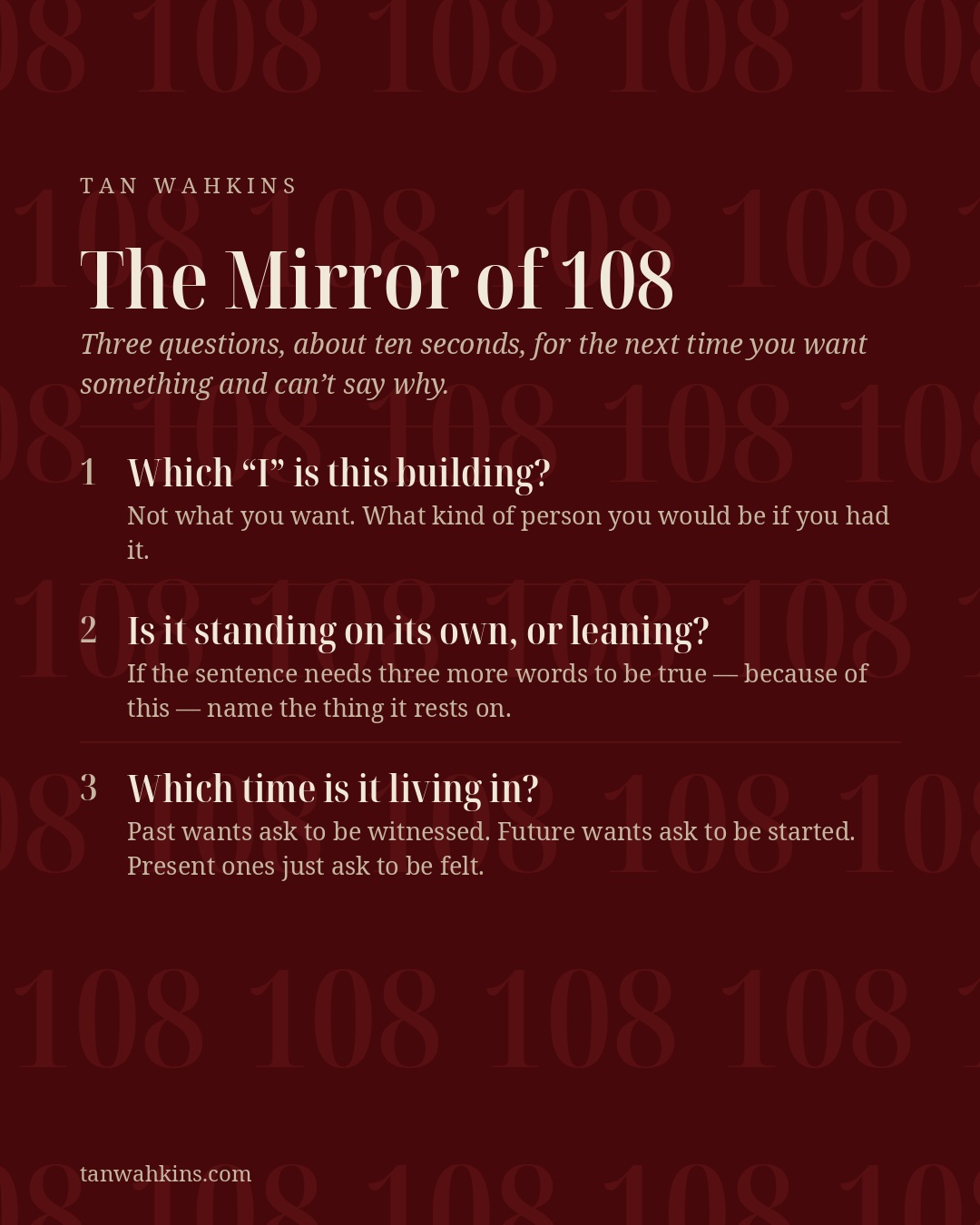
It works like arithmetic. There are eighteen sentence-shapes the mind builds when it wants something. I am. I am here. I am like this. I am otherwise. I am bad. I am good. Then I might be, four ways. Then may I be, four ways. Then I will be, four ways.
Each of the eighteen can stand alone, or lean on something outside itself, in which case three words get added: because of this. Eighteen becomes thirty-six.
Then it multiplies by three, because a craving can sit in the past, the present, or the future.
18 × 2 × 3 = 108.
The second list counts defilements — kilesa — and is arrived at by a different route entirely: sorting mental afflictions into categories and multiplying those. It also reaches 108.
Which one is on the beads
The second one.
The instruction to string 108 comes from a text preserved in Chinese, the Mokugenji Sutra, in which the Buddha tells a king to thread 108 seeds and recite with them to wear down 108 defilements.
Not cravings. Defilements. A different word, a different count, a different question.
So the honest position is this: two separate traditions of counting, working on two different problems, both landed on one hundred and eight. The beads point at one of them. The list I spent a year writing about is the other.
I would have preferred the tidier story. It was not available.
The one that is definitely not real
While looking, I kept meeting a third list — "the 108 defilements," running alphabetically from abuse through aggression, ambition, anger, all the way to wrath. It appears on websites, in printed books, and in more than one product description for prayer beads.
It is not from the Pali canon.
The page most often cited as its source says so itself. The author explains that he received the items from another individual, put them in alphabetical order, and added definitions from a dictionary.
The seams are visible if you look. Envy and enviousness appear as separate entries. So do deceit and deception. A list compiled in a language with eighteen sentence-shapes does not accidentally produce two English synonyms and count them twice.
Why I am telling you the inconvenient version
Because the alternative was to open a book with a nice line about prayer beads and hope nobody checked.
Somebody always checks. And the only thing a book like mine has going for it — against every glossier one on the same shelf — is that its claims can be verified. That advantage survives exactly as long as I do not spend it on a better opening paragraph.
So: the beads are not counting what I write about. The arithmetic in the canon is real, and you can check it in about ten minutes. The alphabetical list circulating online is somebody's compilation from the last few decades, and it should stop being sold as ancient.
All three of those sentences are less satisfying than the myth.
A number that turns up in two traditions is interesting. A number that turns up in two traditions and gets explained as one is just a story nobody stopped to check.